Methane is roughly 27 times worse for the climate than CO2 over a century, and a huge amount of it escapes at small oil and gas sites. The standard fix is a flare, which burns it into CO2. But at small, low-flow sites the flares often fail quietly and let a meaningful share of the methane straight through. Tens of thousands of these small flares operate across the US, and the big industrial solutions don't fit them.
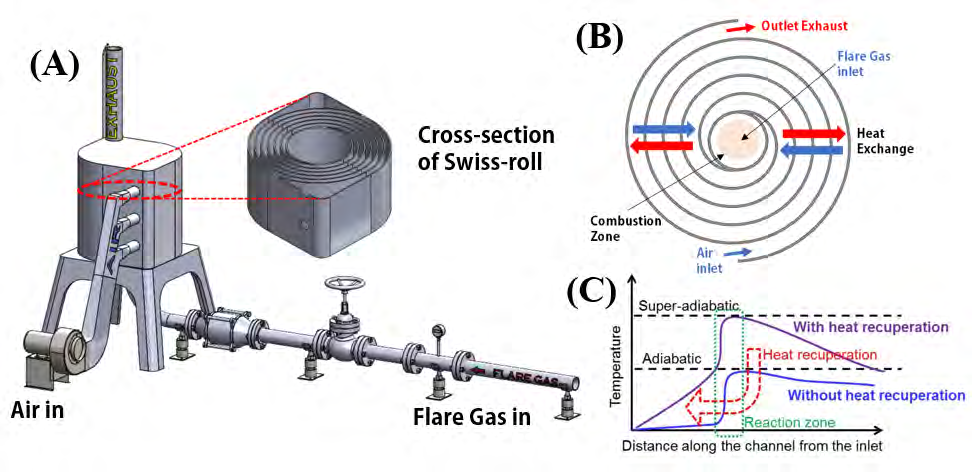
This research, from my time at Advanced Cooling Technologies, developed a combustor sized for exactly those sites. The design is called a Swiss roll: the hot exhaust and the cold incoming gas spiral past each other, so the waste heat from the flame pre-heats whatever comes in next. That recycling lets the burner hold a stable flame on very weak gas streams that would otherwise blow out, destroying the methane thoroughly while keeping temperatures low enough to avoid producing significant NOx, the smog-forming pollutant.
My first-author paper introduced the enclosed version of the concept for small flares. A follow-up the next year made it safer by changing where the fuel enters, removing a flashback risk that shows up when gas flow fluctuates, which at these sites is most of the time.
Relevant publications:
- Adhikari, D.; Bhuripanyo, P.; Rao, P.; Radyjowski, P.; Chen, C.; & Ronney, P. "Swiss-roll Combustor: An Innovative Enclosed Combustor for high Methane Destruction Efficiency and Ultra-low NOX Emissions." American Flame Research Committee Industrial Combustion Symposium, Denver, 2023.
- Radyjowski, P.; Lieberknecht, E.; Adhikari, D.; Rao, P.; Chen, C.; Bhuripanyo, P.; & Ronney, P. "Swiss-roll Combustor: A Compact Portable Solution for Addressing the Methane Emissions from Low-production Oil and Gas Sites." American Flame Research Committee Industrial Combustion Symposium, Calgary, 2024.
Technical detail
The Swiss-roll geometry is a spiral counterflow heat exchanger wrapped around the combustion chamber. Hot products and incoming reactants exchange heat continuously along the spiral, so reactants enter the chamber already hot, pushing the flame above its adiabatic temperature ("super-adiabatic" combustion). That extends the flammability limit far enough to sustain stable combustion on very lean, low-flow methane streams that conventional burners can't hold, while the effective peak temperature stays low enough to suppress thermal NOx formation.
The scale of the target problem: about 97,000 flares were reported in Texas in 2017, roughly a third burning under 20 MSCFD, and existing units below 100 MCF/day can fall under 95% destruction efficiency. The 2024 design revision moved fuel injection near the combustion zone instead of premixing at the inlet, eliminating flashback and auto-ignition risk under the flow fluctuations typical of small production sites.