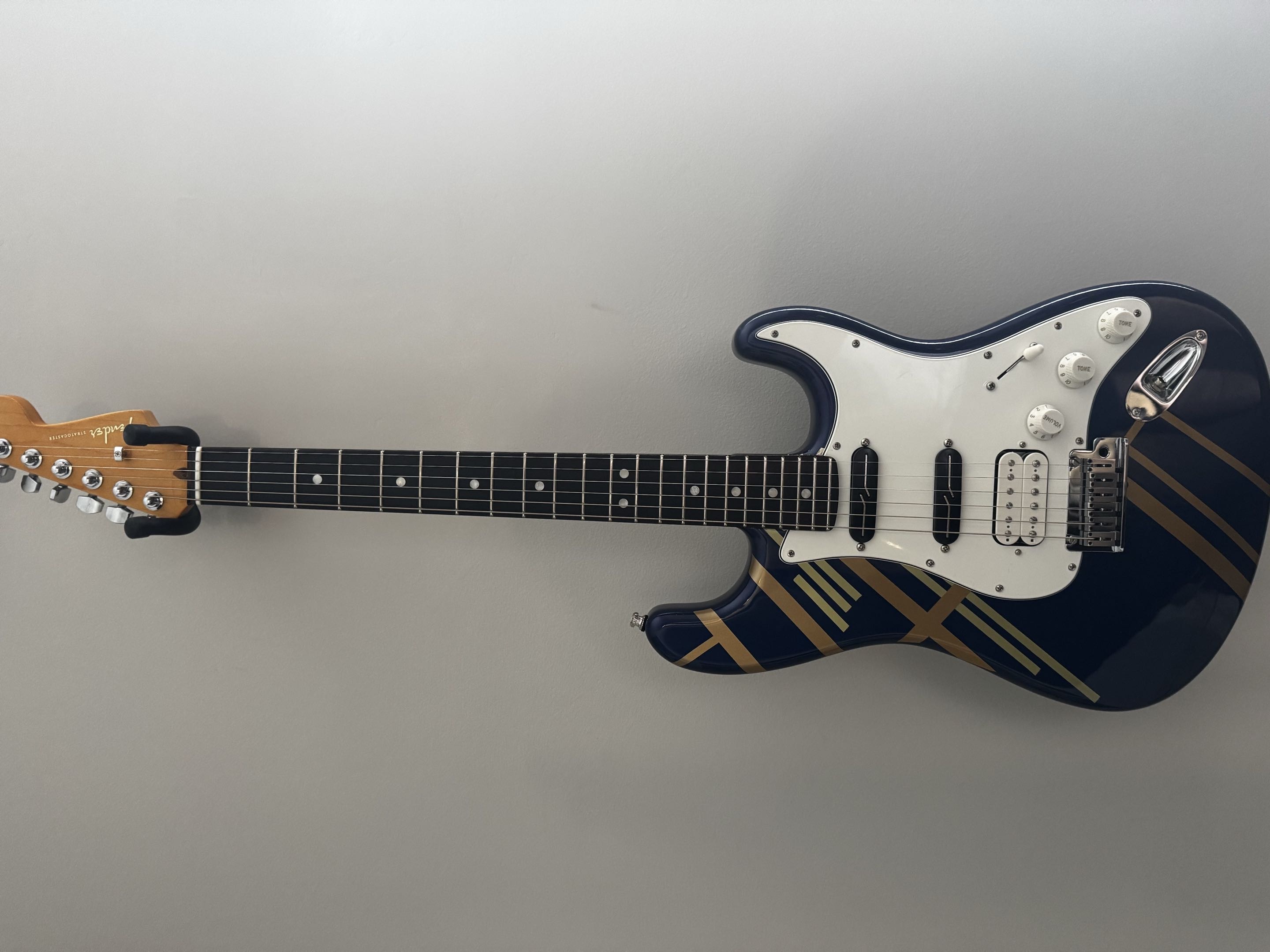
Rather than buy a guitar off the shelf, I built one: I picked the body, neck, pickups, and hardware piece by piece and assembled the instrument myself. Then I kept going.
The main modification came from a sound problem. The effects I use most, fuzz and treble boosters, are vintage-style circuits that only sound right when they're the very first thing the guitar signal hits. But I play through a wireless system, which normally sits between the guitar and everything else and spoils exactly that interaction. So I built the effects into the guitar itself, with a switch on the body that sends the signal through fuzz, through the booster, or straight out, in the correct order before the wireless ever sees it.
A few things fell out of building it this way. There's no pedalboard cable to trip over and no order to get wrong; the guitar itself holds the first stage of my sound, and one flick chooses fuzz, boost, or clean bypass. The electronics were planned so pickups and controls can be swapped or expanded later without a rewire. And the onboard circuits only draw battery while a cable is plugged in, so the guitar can't quietly drain itself sitting in its case.
The companion project came from the amplifier side of the rig. Running two tube amps into one speaker cabinet is genuinely risky: if an amp is ever left connected to nothing, even for a moment, it can destroy itself. I designed and built switch boxes that make that impossible. One physical switch swaps which amp drives the cabinet and which runs into a safe load, and the wiring guarantees both amps are always connected to something, no matter what.
None of this was my field going in. I learned instrument electronics, soldered and tested every circuit, and reworked the wiring until it all survived actual use.
Under the hood
The reason the onboard placement matters: classic fuzz circuits (Fuzz Face-style) are low-input-impedance devices designed to interact directly with the pickup coil. A wireless transmitter, or any buffer, presents them with a low-impedance source instead, which changes the EQ, the cleanup behavior, and the feel. Mounting the circuits before the transmitter restores the interaction the circuits were designed around.
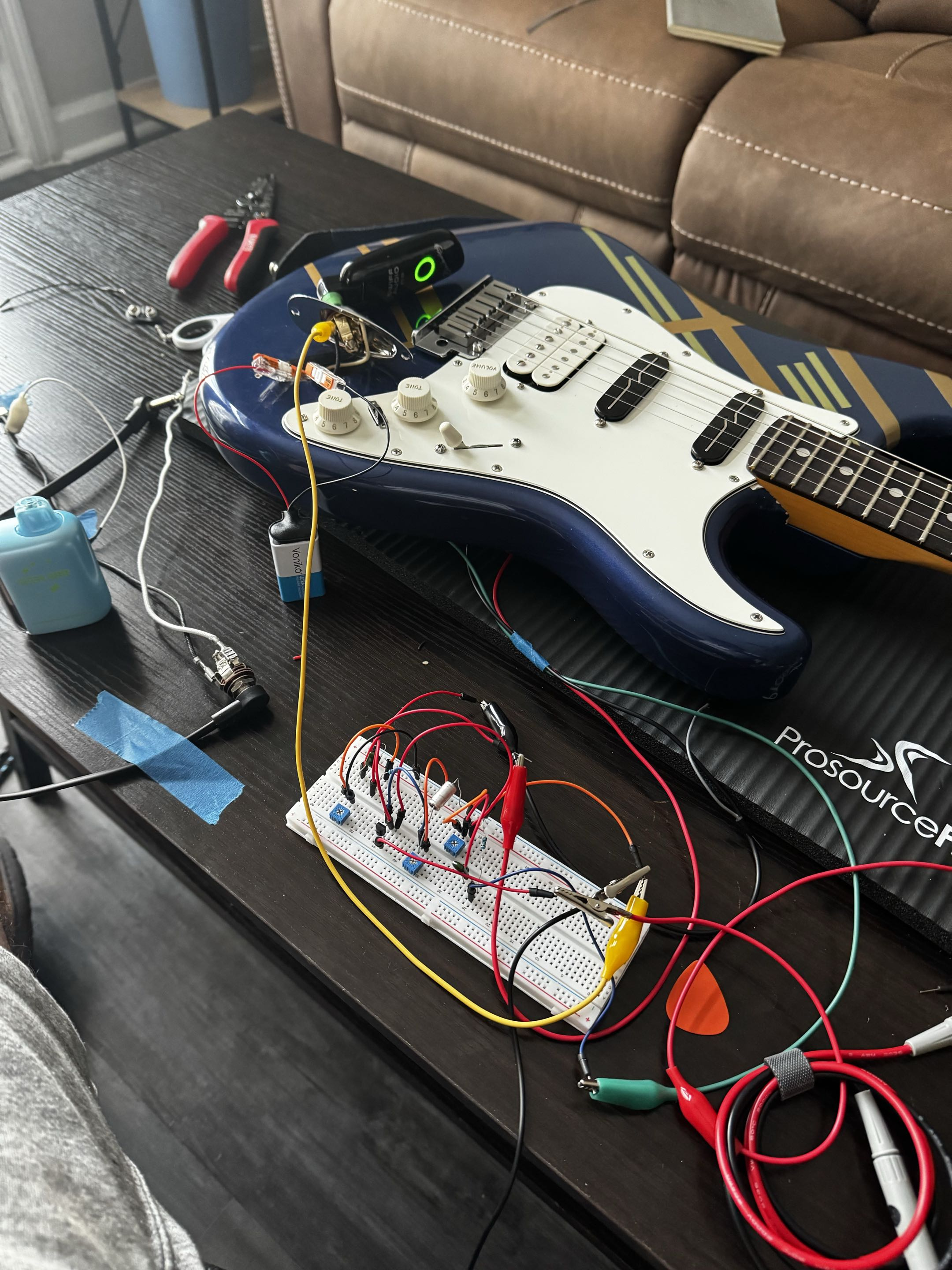
The build runs 500K pots (the right value for humbucker-class and noiseless pickups; single-coil tradition is 250K), with push-pull tone controls considered for coil split, phase, series/parallel, and tone bypass. Pickup candidates documented for the build: Fender Noiseless, Seymour Duncan, DiMarzio Area, Fishman Fluence. The output jack is a switching TRS type; its ring terminal acts as a passive battery disconnect, so the onboard circuits only draw power while a cable is plugged in. All cavity shielding ties to a single star ground point.
The amp switcher
The switch box uses one break-before-make 4PDT switch across four poles: each amp's hot and ground switch together, so one throw routes Amp 1 to the speaker cabinet and Amp 2 to a Captor X load box, and the other swaps them. No output is ever floating, even mid-switch. No relays, no active electronics, no shared load. Four speaker jacks, 16–18 AWG speaker wire, and continuity testing with the amps off before anything powers up. The break-before-make contact sequence is a safety requirement: a tube amp with no load can destroy its output transformer in seconds.