Neutron-scattering facilities are where scientists go to probe the insides of materials, and time on those instruments is scarce, scheduled months ahead, and expensive. A surprising amount of it is wasted waiting. Samples sit inside extremely hot furnaces or extremely cold chambers, and before one experiment can be swapped for the next, the equipment has to come back to a safe temperature. That wait could be two hours or more, several times a day.
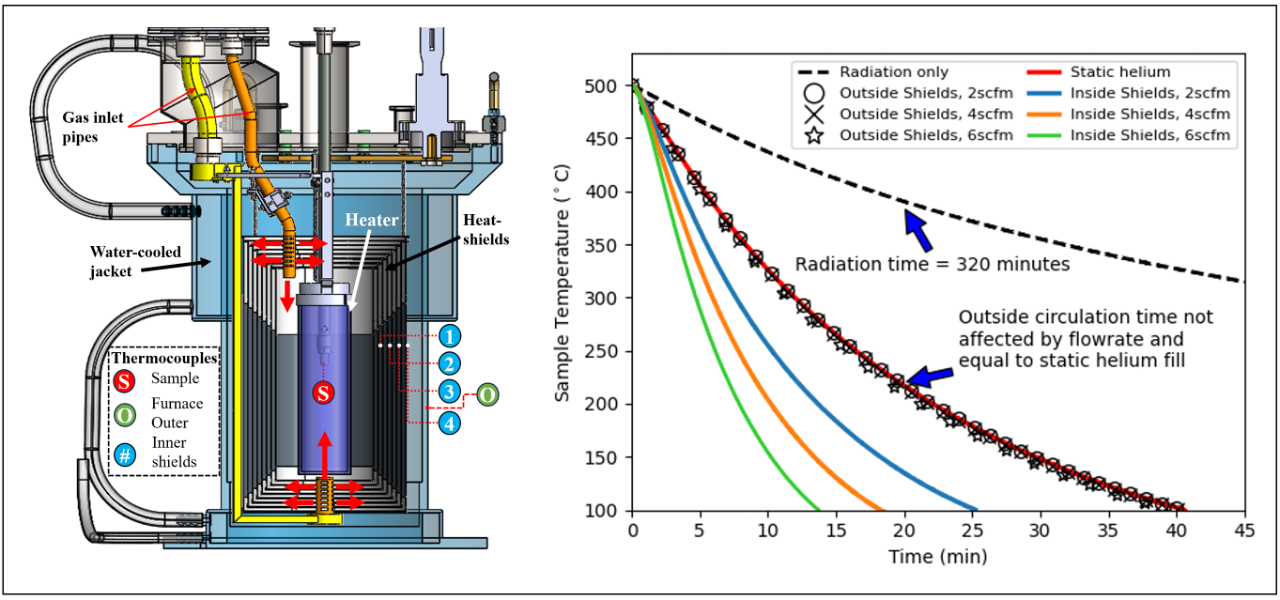
At Advanced Cooling Technologies, I worked on cutting those waits down to minutes. For the furnaces, that meant circulating cold helium through the chamber in a controlled loop, taking the hottest part of the cooldown from over two hours to under five minutes. For the cold chambers, a new sample-holder design used liquid nitrogen to reach deep-cryogenic temperatures in under two minutes instead of about two hours. Just as importantly, the team turned the measurements into design rules, so future systems can be engineered on paper with confidence instead of by trial and error.
The work was published across journals and conferences, including a featured article in the journal Review of Scientific Instruments. The point of it all: let neutron facilities run substantially more experiments with the same beam time.
Related publications:
- Adhikari, D.; Quirinale, D.; Radyjowski, P.; Thurman, Z.; Yu, D.; Chen, C.; An, K.; & Mills, R. "Automated Rapid Cooling of High Temperature Vacuum Furnaces for High Throughput Neutron Experimentation." Rev. Sci. Instrum. 97, 063303, 2026. (Featured Article)
- Adhikari, D.; Radyjowski, P.; Carlson, D.; Davis, R.; Zou, A.; Rao, P.; & Chen, C. "Rapid Cooling Technology for Extreme Sample Environment Neutron Vacuum Furnaces." ASME HT2024-130519, 2024.
- Zou, A.; Davis, R.; Winters, D.; Carlson, D.; Adhikari, D.; Radyjowski, P.; & Chen, C. "Fast Cooling Technology for Sample Stick in Top Loading Cryostats." ASME SHTC2024-131033, 2024.
- Page, A.; Davis, R.; Adhikari, D.; Radyjowski, P.; Shaeri, M. R.; & Chen, C. "Correlation for Heat Transfer Coefficient for Rapid Cooling of Neutron Vacuum Furnaces." ASME SHTC2025-156615, 2025.
- Radyjowski, P.; Davis, R.; Adhikari, D.; Chen, C.-H.; & Mills, R. "Rapid Cooling Technology for Neutron Vacuum Furnaces", 12th International Workshop on Sample Environments at Scattering Facilities, Bastad, Sweden, September 2024.
Technical detail
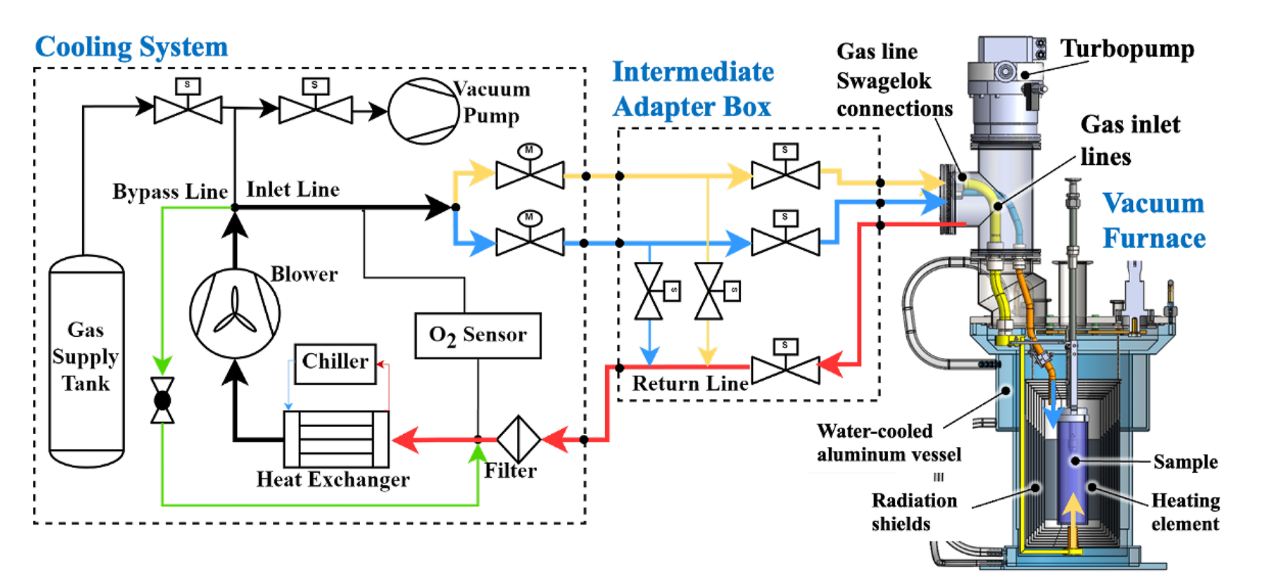
The furnace system uses closed-loop circulation of low-pressure helium as the working gas, automated so the cooldown runs without operator intervention. The headline figure covers the most consequential part of the cooldown, 500°C down to 100°C, where radiation alone is slow: over two hours conventionally, under five minutes for low-thermal-mass cases with no sample. The cryostat sample stick embeds a liquid-nitrogen transport line and exploits LN2 boiling to pull room-temperature samples down to ~80 K in under two minutes, versus roughly two hours for a typical dry cryostat.
The design-rules side of the work produced a Nusselt-number correlation validated across helium, nitrogen, argon, and a nitrogen–helium mixture, within a maximum deviation of 15.7% from the measured experimental values. Heat transfer coefficients for new furnace configurations can be predicted rather than re-measured.
The systems and the deployment
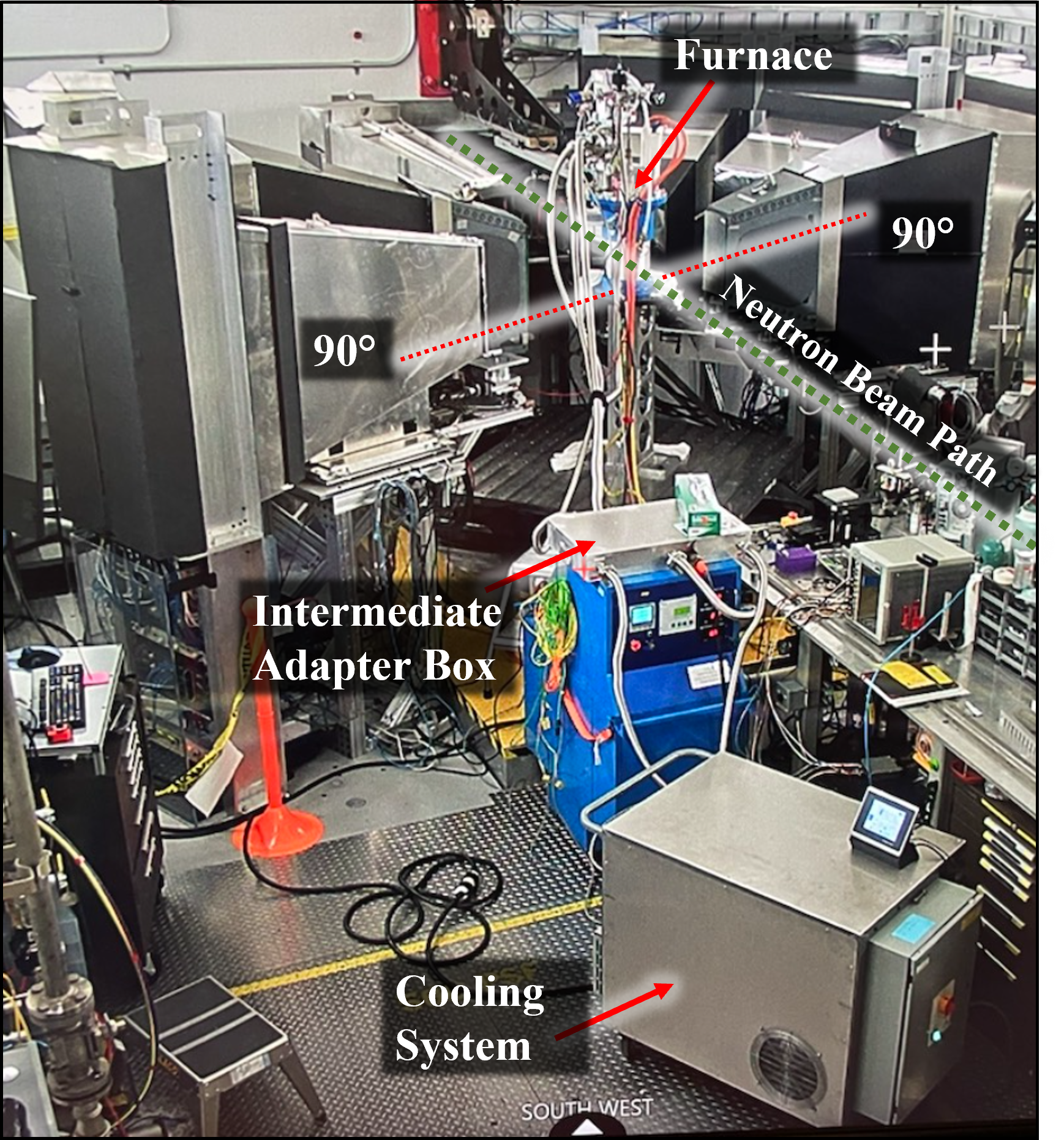
The first figure shows the rapid-cooling design loop as it integrates with the vacuum furnace: the closed helium circuit (blower, chiller, heat exchanger, and filter) on the left, the intermediate adapter box routing the inlet, return, and bypass lines, and the vacuum furnace itself on the right with its turbopump, water-cooled aluminum vessel, radiation shields, and heating element around the sample. The second figure shows the deployed system at the VULCAN beamline.