Tissue engineers grow cells on scaffolds, soft sponge-like materials that give cells something to live in. One promising kind is made of countless microscopic gel particles packed together, and the spaces between the particles are where cells move in and grow. What researchers lacked was a simple, controllable way to tune that structure, and a clear picture of what changing it does to the cells.
This study, by a large multi-institution team at Penn State, found that knob: centrifuging the particles, essentially spinning them into a tighter or looser packing. Tighter packing shrinks the pores and makes the scaffold stiffer. Looser packing does the opposite. And the cells notice. Cancer cells spread out flat in loosely packed scaffolds but stretched into elongated shapes in tightly packed ones, and in animal implants, loosely packed scaffolds welcomed more of the body's own cells moving in to build tissue.
In other words, one adjustable step at manufacturing time controls both the material's feel and its biological behavior, a practical lever for designing scaffolds for different jobs. I contributed as a middle author on the team, well outside my home field, and it remains the most collaborative piece of science I've been part of.
Relevant publication:
- Jaberi, A.; et al.; Adhikari, D.; et al. "Engineering Microgel Packing to Tailor the Physical and Biological Properties of Gelatin Methacryloyl Granular Hydrogel Scaffolds." Advanced Healthcare Materials, 2024. DOI: 10.1002/adhm.202402489.
Technical detail
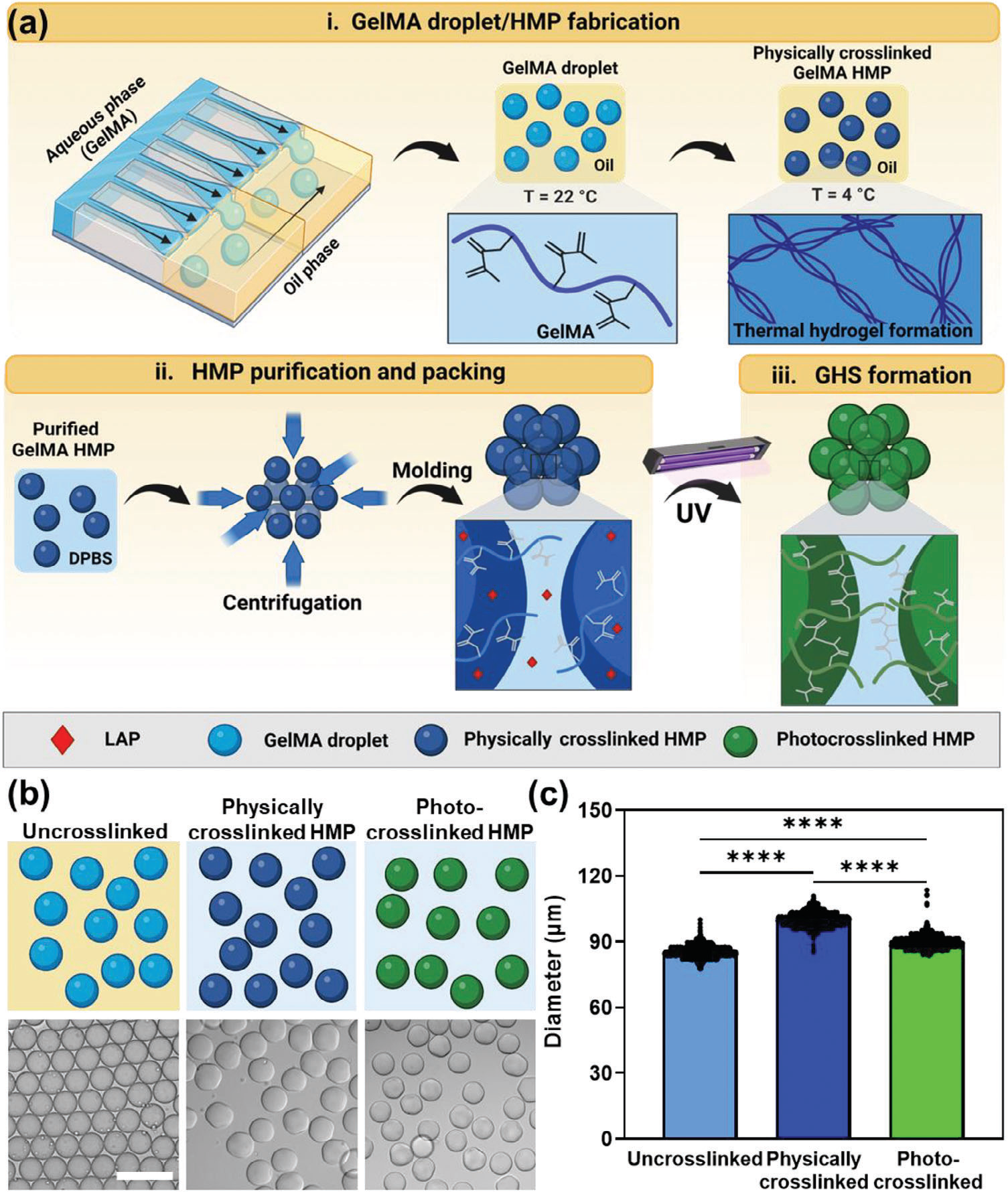
The scaffolds are gelatin methacryloyl (GelMA) microparticles packed by centrifugal force. Increasing force or duration increased packing density, which decreased void fraction and pore diameter and raised compressive and storage moduli. Cell response tracked the structure: MDA-MB-231 breast cancer cells spread and flattened in loosely packed scaffolds but elongated under the spatial confinement of highly packed ones, and in vivo mouse implantation showed greater endothelial, fibroblast, and macrophage infiltration in lower-packing-density scaffolds.
How the scaffolds are made
The figure below, from the paper, shows the fabrication route. GelMA is formed into droplets, crosslinked into microparticles, then packed by centrifugation into the granular scaffold; tuning the centrifugation sets how tightly the particles pack, which is the lever that controls pore size, stiffness, and how cells behave inside.