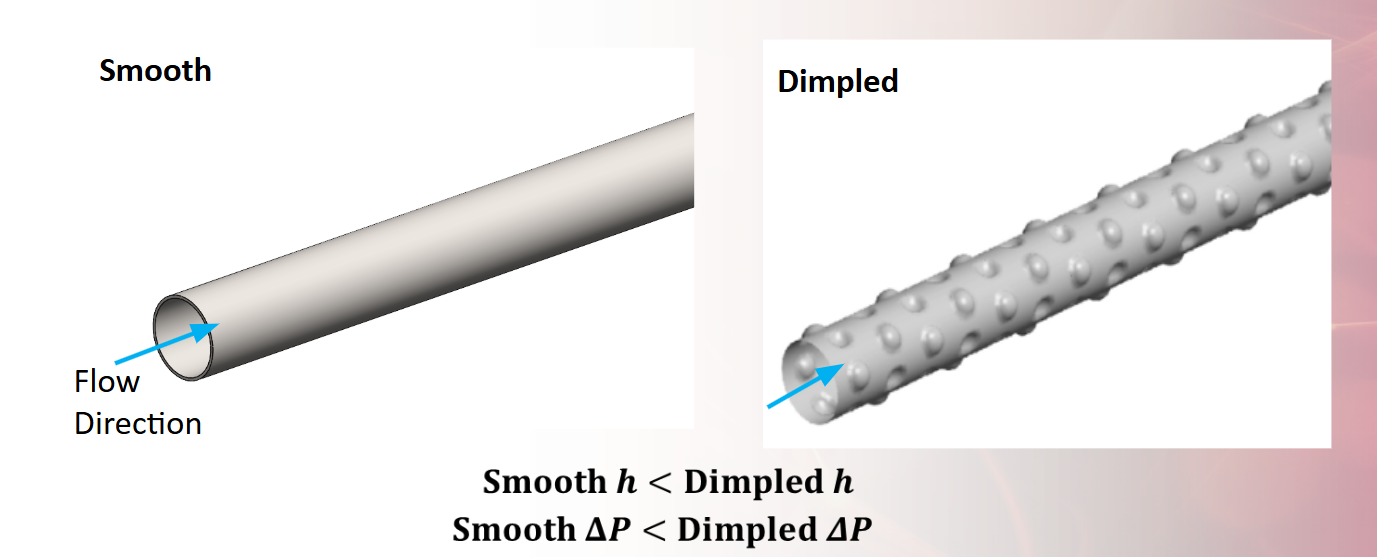
As electronics get smaller and more powerful, keeping them cool gets harder, and the shapes that cool them best keep getting more exotic. One promising approach uses channels covered in small dimples, which stir the coolant into carrying more heat away. The problem is that nobody has reliable formulas for these shapes. The only trustworthy way to evaluate a design is a detailed computer simulation, which can take days per candidate, so engineers end up over-designing or settling for something mediocre.
This project replaced most of that waiting with machine learning. We generated a training set of simulations covering a range of dimpled-channel designs, then taught a model to look at a geometry it had never seen and predict how well it would cool and how hard the pump would have to work.
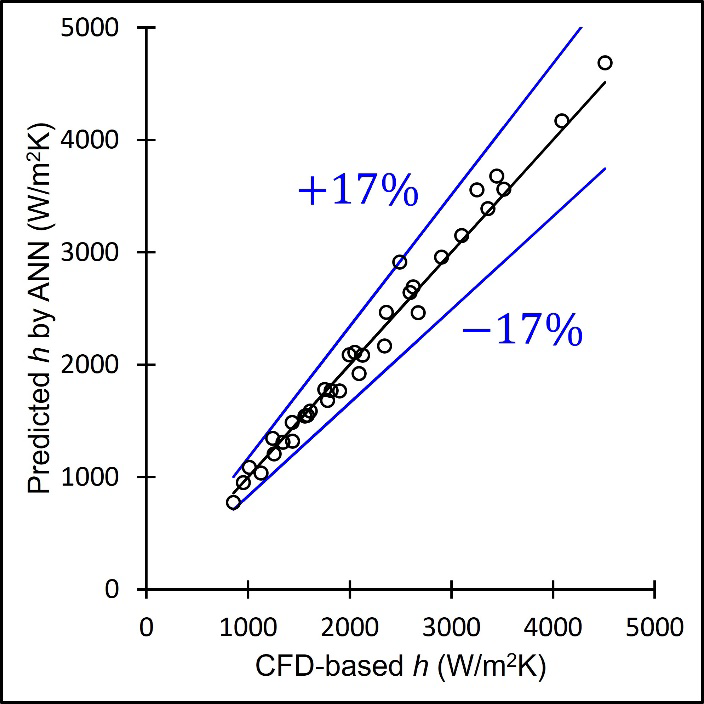
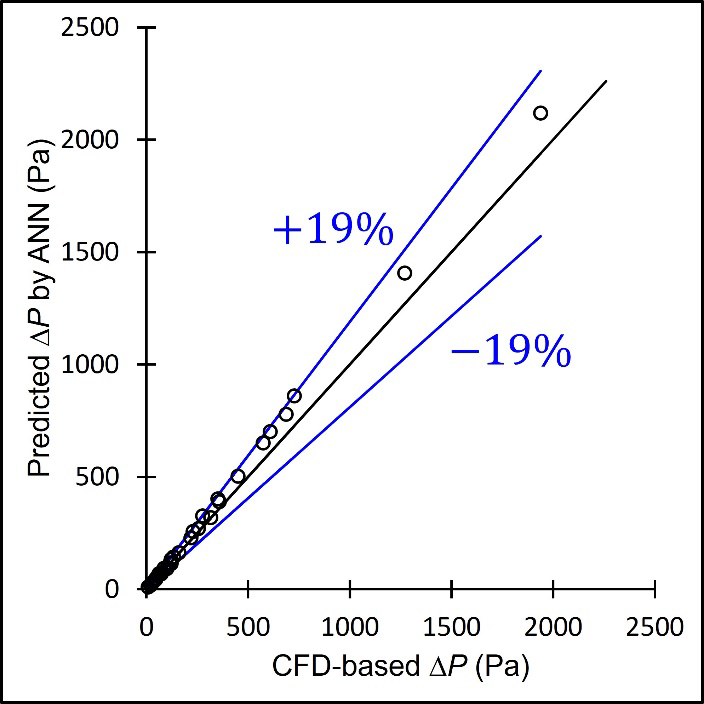
The predictions landed close to the true simulated values, within roughly a fifth of the actual figure for both cooling performance and pumping cost. That's accurate enough to screen dozens of candidate designs in seconds and send only the best few to full simulation, turning a days-long exploration into an afternoon.
Relevant publication:
- Shaeri, M. R.; Randriambololona, A. M.; & Adhikari, D. "Machine Learning Algorithm for Predicting Heat Transfer Coefficient and Pressure Drop in Dimpled Ducts." ASME Heat Transfer Summer Conference, 2024.
Technical detail
The model is a fully connected artificial neural network trained on a limited CFD-generated dataset of water-cooled dimpled ducts, with no pre-existing input-output correlation to lean on. On held-out dimpled-duct geometries it predicted heat transfer coefficients within ±17% and pressure drops within ±19% of the simulated ground truth, sufficient fidelity to screen candidate geometries before committing any of them to full CFD or experiment.
Results
The two plots below compare the model's predictions against the simulated ground truth on dimpled-duct geometries it never saw during training. The first is heat transfer coefficient (how well the duct cools), the second is pressure drop (how hard the pump has to work); points hugging the diagonal line mean the prediction matched the simulation.